A Study on Structural Improvement Strategies for Sustainable School Meals (2025)
Principal Investigator: Hyunsil Cho, Policy Research Institute, Korean Public Service and Transport Workers’ Union
Co-Researchers:
Inim Han, IEUM Policy Research Institute
Jiyoon Jung, MD, Specialist in Occupational and Environmental Medicine
Cheonghee Yu, Korea Institute of Labor Safety and Health
- Background
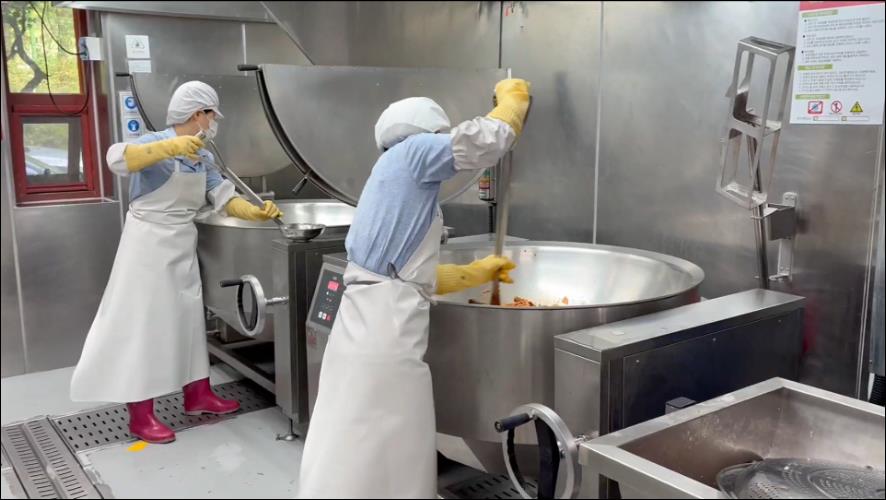
School meals are a core public welfare policy area encompassing the protection of students’ right to health, dietary education, and regional circular economies. However, despite the nationwide expansion and institutional establishment of school meals, the working conditions of the meal workers who actually sustain this system have long been neglected. In particular, excessive student-to-cook ratios, increased variety of side dishes, complex cooking processes, and poor working conditions increase labor intensity and health risks, threatening the sustainability of school meals. This study aims to reexamine the quality and sustainability of school meals from the perspective of ‘labor sustainability’ and derive structural improvement measures.
- Methods
This study applied a mixed-methods approach combining surveys, field investigations, and biometric measurements targeting school cafeterias nationwide. A survey on working conditions and labor intensity was conducted among 2,605 school meal preparation workers nationwide, with field observations performed at selected schools. Additionally, heart rate measurements were taken at different work intervals for 8 food service workers to objectively analyze the physical burden of school meal preparation using physiological indicators. Furthermore, school meal-related laws, systems, and the Office of Education’s operational guidelines were reviewed to analyze institutional limitations.
- Results
Survey results indicate that a majority of school meal preparation workers perceive several factors as major contributors to increased work intensity: excessive meal service capacity per cook, an increased variety of side dishes, time pressure, insufficient rest and break facilities, and a lack of substitute staff. In particular, the normalization of early shifts, short meal and rest time, and restrictions on using sick leave and annual leave were identified as factors intensifying workers’ physical and mental exhaustion and health risks.
Heart rate measurements revealed a pattern of rapid increases to 150 bpm or higher immediately before serving meals and during cooking process transitions, corresponding to a moderate-to-heavy physical labor level. This physiological burden showed significant consistency with the subjective perception of labor intensity confirmed through the survey.
Combining the survey and field investigation results, it was confirmed that the following structural factors are acting to compound and amplify labor intensity: increased number of diners per cook, excessive variety of side dishes, frequency of handling heavy items, poor ventilation, and a hot and humid work environment. Based on the analysis, it was determined that setting an upper limit of 80 to 100 students per cook is desirable. It was also found that maintaining the current operational system raises concerns about workforce attrition in school meal services and weakens the sustainability of the school meal system.
- Conclusions and Policy Implications
This study empirically demonstrates that the quality of school meals is determined not merely by menu composition or hygiene management, but also by structural conditions enabling rational and safe cooking practices. Unless the health and safety rights of food service workers are guaranteed, the public nature and sustainability of school meals cannot be maintained. Therefore, school meal policy must adopt a core direction of transitioning toward “labor-respecting public services.”
This study proposes key policy tasks: legalizing staffing standards; establishing nationwide common standards for staffing and operations; calculating staffing levels taking into account cooking processes and the number of side dishes; improving cafeteria environments by expanding ventilation, automation equipment, rest areas, and cooling spaces; and institutionalizing a substitute workforce pool. These policy recommendations go beyond mere facility upgrades or workforce expansion; they are essential conditions for restructuring the entire school meal system into a sustainable public service. Moving forward, substantive institutionalization is required at both the local Offices of Education and the central government levels.
Comments