 Ensuring the Right to Safe and Healthy Work: Why the Revised Trade Union Act Matters (Nov. 2025)
Da-hye Park, Attorney, Goreun Law Firm
Korea Institute of Labor Safety and Health
Translated by Michelle Jang
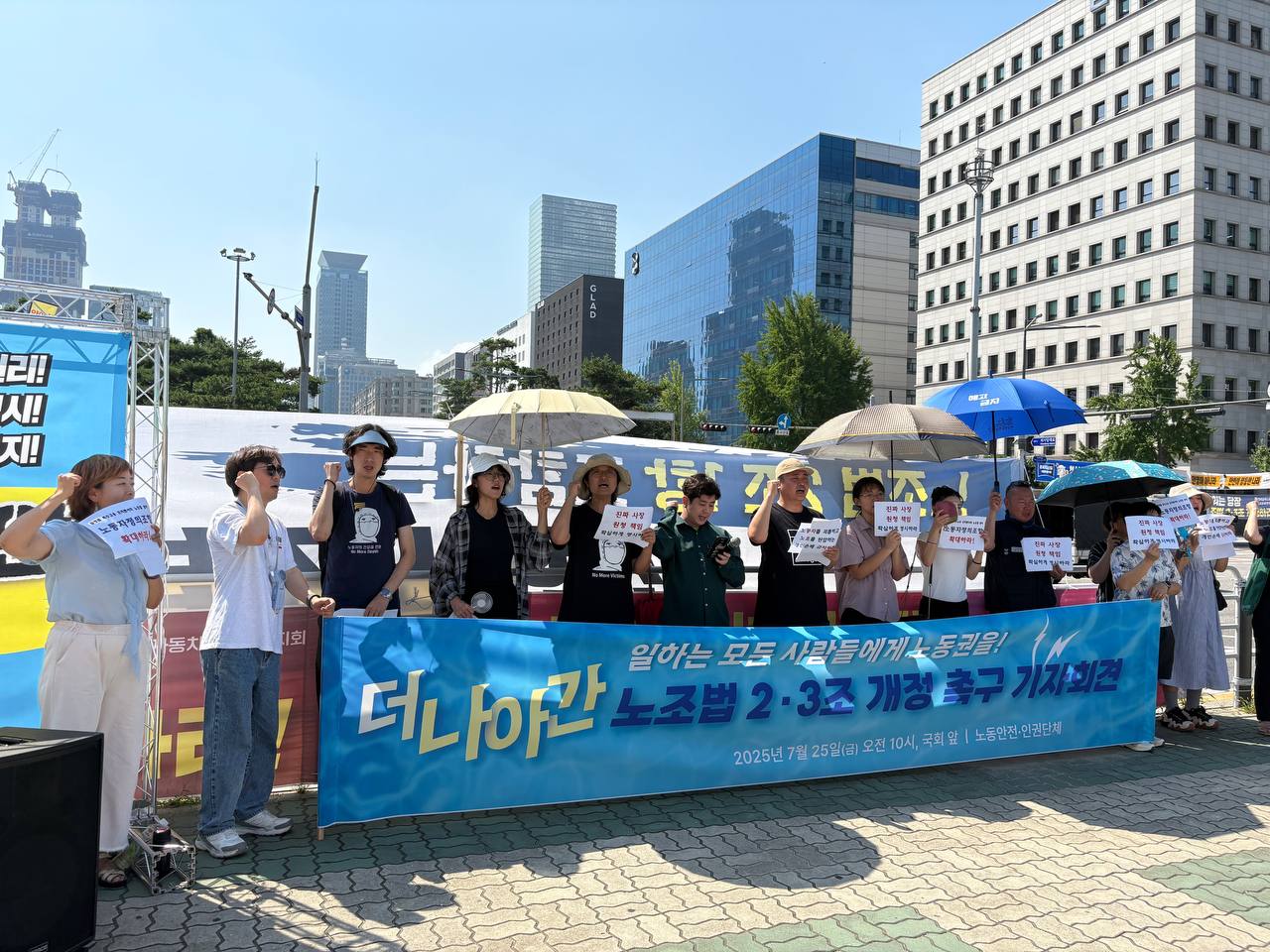
A partial amendment to the Trade Union and Labor Relations Adjustment Act (hereinafter the “Trade Union Act”), commonly referred to as the “Yellow Envelope Act,” passed the National Assembly’s plenary session on August 24, 2025, and is set to take effect on March 10, 2026. The amendment consists of four key changes. First, it expands the definition of “employer” to include those who, despite not being parties to the employment contract, hold substantial and specific control or decision-making authority, thereby enabling collective bargaining between prime contractors and subcontractors’ unions. Second, it removes the current provision that disqualifies an organization as a labor union if it admits members who are not workers. Third, it broadens the scope of “labor disputes” to include managerial decisions that affect working conditions as well as violations of collective agreements by employers. Fourth, it introduces new rules that bar employers from seeking damages for losses resulting from union activities other than collective bargaining or industrial action. It also establishes standards for determining the extent of individual workers’ liability when damages from industrial action are recognized and provides grounds for claims for reduced compensation or exemptions from liability.
History of the Debate Over Revising the Yellow Envelope Act
The origins of the debate over revising the Trade Union Act—commonly known as the “Yellow Envelope Act”—are said to date back 22 years. In 2003, Dal-ho Bae, a bargaining representative of the Doosan Heavy Industries & Construction labor union, died by self-immolation after suffering under the company’s claims for damages and provisional seizure. His death prompted members of the 17th National Assembly to introduce bills aimed at limiting the grounds and extent of damage claims related to industrial action.
Public attention to the legal issue intensified in 2013, when a lower court ordered the Ssangyong Motors branch of the Korean Metal Workers’ Union to pay 4.7 billion won in damages stemming from the company’s 2009 strike. The strike had erupted in response to restructuring at Ssangyong Motors, even though the collective agreement explicitly required the company to reach an agreement with the branch before implementing layoffs “due to managerial needs.” Nevertheless, the court ruled that the strike could not be justified even with such a clause in place, holding the branch liable for damages. The ruling sparked a nationwide campaign in which citizens donated money in yellow envelopes—an act that gave rise to the name “Yellow Envelope Act.”
During the 19th and 20th National Assemblies, multiple bills were introduced to limit unions’ liability for damages, prohibit damage claims against individual union members, and expand the scope of legally protected industrial action. In 2022, a renewed wave of debate emerged following a 47 billion won damages claim against subcontracted workers involved in the Daewoo Shipbuilding strike. The case not only underscored the problem of astronomical damage claims, but also shed light on the structural difficulties subcontracted workers face in exercising their rights to collective bargaining and collective action under poor working conditions. Despite these developments, the amendment bill passed by the 21st National Assembly was ultimately nullified when it was vetoed by the sitting president.[1]
The major issues addressed in the revised law—such as expanding the definition of “employer,” problems arising from the provision that a union is not recognized as such if it admits non-employees, whether managerial matters and rights disputes should be included within the scope of labor disputes, and limits on the civil liability of union members—are not questions for which the legislative process has newly discovered answers. These matters have long been the subject of extensive theoretical and practical debate, shaped over many years by case law and academic scholarship. The revision simply marks the belated codification of issues that have been discussed for decades.
The Significance of the Revised Trade Union Act
Notably, the revised law expands the definition of “employer” by adding a provision to the latter part of Article 2, Paragraph 2, which states: “Even if not a party to an employment contract, a person in a position to substantially and specifically control or determine a worker’s conditions of employment is considered an employer within that scope.” This provision codifies principles that have long been established through court precedents.
In its March 25, 2010, ruling in case 2007du8881 (the Hyundai Heavy Industries case), the Supreme Court held that even if a party is not the employer who directly entered into an employment contract with a worker, if that party has the power to substantially and specifically control the worker’s basic employment conditions, they qualify as an employer subject to orders addressing unfair labor practices. Although this decision involved an unfair labor practice dispute, it fundamentally emphasizes the need to identify and hold legally accountable the party that bears actual responsibility. More recently, several lower court decisions, following the reasoning of rulings by the Central Labor Relations Commission, have recognized the expanded concept of “employer” by determining that a prime contractor’s refusal to engage in collective bargaining with a subcontractor union constitutes an unfair labor practice.
In other words, the courts have expanded the definition of “employer” by recognizing the prime contractor as an employer in cases involving labor law issues, such as unfair labor practices against a subcontractor’s union. They have also affirmed that a single worker or labor relationship can have more than one employer—a principle that is now reflected in the revised law.
In fact, the courts’ position—and the revised labor union law reflecting it—echo concepts that are already familiar in occupational safety and health legislation. Recognizing the practical necessity of protecting workers, the law goes beyond the narrow formality of a single employment contract between one employer and one worker, assigning responsibilities to prime contractors and managers.
Since the enactment of the Serious Accidents Punishment Act, prime contractors and CEOs have been held liable in cases where a subcontracted worker dies; in some instances, even the chairman of a corporate group, rather than a specific affiliate, has been prosecuted. Under the Act, the duty to ensure workplace safety and health applies to “workers” in any business or workplace that the employer substantially controls, operates, or manages. It does not depend on whether the deceased worker was formally employed by that employer. If a violation of this duty occurs and is causally linked to a death, the employer and responsible managers are held accountable for the resulting harm.
Although the Occupational Safety and Health Act does not provide the same comprehensive protection as the Serious Accidents Punishment Act, its recent comprehensive revision expanded contractors’ obligations, creating overlapping responsibilities for both prime and subcontracting employers toward subcontracted workers. Given the fragmented and differentiated nature of modern labor, this legislative approach is entirely reasonable, as it aligns authority with responsibility for preventing workplace accidents.
As noted earlier, the Supreme Court recognized the de facto control of prime contractors over subcontracted workers long before the Trade Union Act was amended to expand the definition of “employer.” It is particularly important to note that a key factor in recent lower court rulings, which acknowledge prime contractors’ de facto control over workplace safety and health issues, is the purpose and substance of occupational safety and health legislation.
The Need for and Challenges in Revising the Trade Union Act to Protect Workers’ Health
Occupational safety and health laws already aim to cover all workers in the workplace—not just formal employees. Yet, without collective participation guaranteed through union activities or collective bargaining, it is virtually impossible for individual workers to identify hazards, demand action from the company, or halt unsafe work. For irregular workers, who face higher risks and more dangerous tasks, reporting hazards to the prime contractor and demanding corrective measures is almost unimaginable. Even when a subcontractor union exists, the situation is largely unchanged.
While it is important to form and operate joint Industrial Safety and Health Committees under the prime contractor’s safety management system, this carries less weight than negotiating with the prime contractor and engaging in collective action to secure binding collective agreements that go beyond the limitations of deliberative and decision-making structures.
This underscores why revising the Trade Union Act was urgently needed: to ensure that progress in occupational safety and health laws moves beyond merely strengthening punishment toward institutionalizing prevention. Punishment is indeed a powerful preventive tool, but the reality since the implementation of the Serious Accidents Punishment Act shows that punishment—or the threat of it—alone does not automatically prevent accidents.
Labor unions, as a constant monitoring mechanism and key actor in the workplace, are essential for raising safety and health standards and preventing accidents through collective bargaining and organized participation. It is a natural consequence of the exercise of constitutional rights to a safe workplace and the three fundamental labor rights that unions demand negotiations with the entities that actually determine working conditions—such as safe and healthy work environments and fair wages that enable these conditions to function effectively.[2]
Finally, I hope this legislative revision provides an opportunity to reflect on whether occupational safety and health laws have been fully and effectively applied in workplaces. It is now time to go beyond merely ensuring the stable and thorough implementation of the Serious Accidents Punishment Act solely as a basis for demanding strict penalties when a serious accident occur. It is time to go beyond diligently conducting routine safety and health measures such as musculoskeletal hazard investigations and risk assessments. It is time to seriously recognize the safety and health concerns of non-regular workers and to concretely consider joint negotiations between prime contractors and subcontractors and negotiations across multiple companies.
[1] This paragraph and the subsequent explanation of the revised Trade Union Act are summarized with reference to Gwi-cheon Park’s presentation, “The Purpose, Necessity, and Evaluation of the Amendment of Articles 2 and 3 of the Trade Union and Labor Relations Adjustment Act,” delivered at the 2025 Korea Labor Law Association Policy Forum, “Turning Points in the Trade Union Act: Implications and Challenges of the Amendment of Articles 2 and 3.”
[2] See the author’s presentation at the National Assembly forum on the necessity of amending Articles 2 and 3 of the Trade Union Act to protect workers’ right to health, titled “The Necessity and Significance of Revising Articles 2 and 3 of the Trade Union Act to Ensure Workers’ Right to Health.”
Comments