The Invisible Trap: Surveillance Technology (Dec. 2025)
Yong-hyun Im, Activist
Korea Institute of Labor Safety and Health
Translated by Michelle Jang
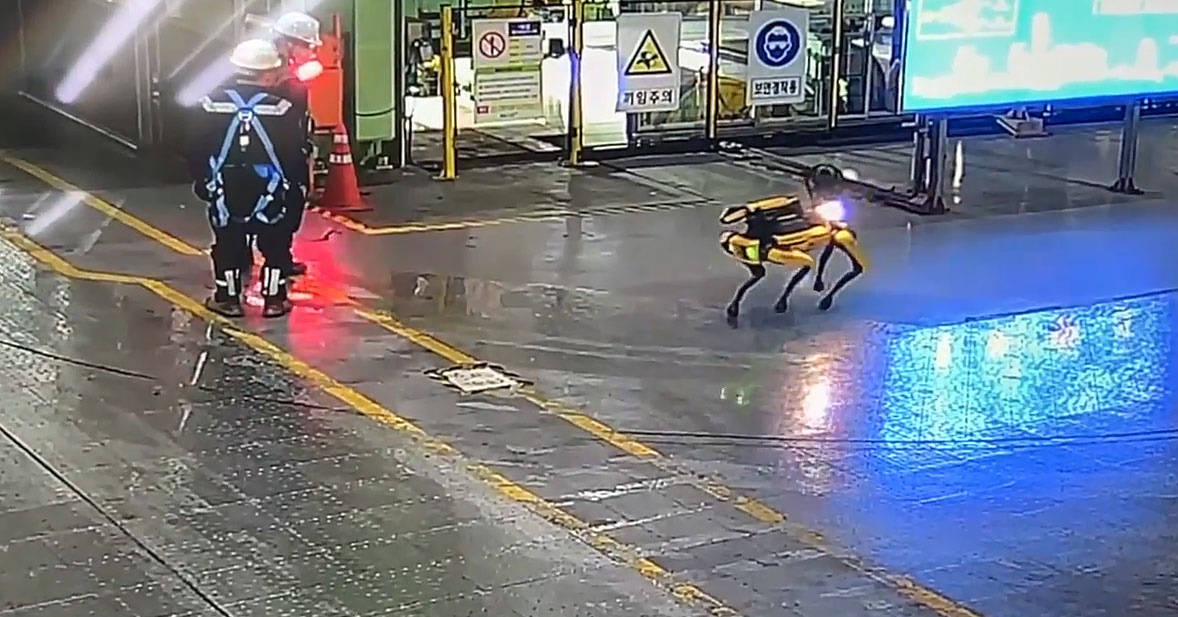 A robot dog patrolling the site of the second cold rolling mill at Hyundai Steel’s Dangjin Plant. Photo: Hyundai Steel’s irregular workers’ branch
According to the Korean dictionary, surveillance is defined as “carefully watching in order to enforce discipline.” In most cases, surveillance is carried out to control another person’s negligence or deviation. Therefore, it often operates on the assumption of an asymmetrical power relationship. In these situations, those in power create environments that make it easier to monitor and control the weak in order to protect their vested interests.
The history of surveillance is, in fact, a long one. As social classes began to diverge, surveillance systems emerged as a means for a privileged minority to oppress and exploit the majority. Surveillance of sites of production, in particular, has functioned as an effective tool for advancing the interests of the ruling class, from ancient times to the present. Since the emergence of agricultural societies some 10,000 years ago, humans have domesticated animals such as dogs, cattle, horses, pigs, and chickens—using them as sources of food and for farming, transportation, and hunting. In this sense, it is presumed that the earliest objects of surveillance were livestock. In terms of identifying those under watch one by one, restricting their freedom of movement, and managing their performance, the essence of surveillance has not changed all that much even today.
The introduction of factory-style systems and the subsequent spread of wage labor established workplace discipline based on time management. Today, technological advances have further intensified workplace surveillance regimes. In most workplaces, surveillance is now accepted as something as natural as the air we breathe. Faced with this reality, how do labor union activists perceive and respond to the growing normalization of surveillance in the workplace?
Coupang Yeoju Logistics Center: Preventing ‘unauthorized’ product removal? Labor control is a bonus!
In many workplaces, electronic surveillance is commonly installed under the guise of facility safety, security, or accident prevention. However, in numerous cases across various sites, these systems are used far beyond their stated purposes, serving as tools for labor control and monitoring. First, let’s look at an example from a logistics center.
Ae-sook Jung, branch chief at the Coupang Yeoju Logistics Center and a member of the Public Transport Workers’ Union, National Logistics Center Branch, has worked there for four years. She explained that CCTV, originally installed “to prevent theft of delivery items,” monitors workers’ every move in real time. At this site, staff are primarily responsible for inspecting returned items—products sent back due to customer change of mind or defects—and preparing them for resale. Jung herself handles tasks such as checking the reason for each return, assessing the condition of the item, and deciding whether it should be resold or discarded. She noted that with Coupang’s rapidly increasing sales, the volume of returned goods has soared accordingly.
However, due to the nature of the returns process—where products often come back with opened packaging or signs of use—the work area is under constant, all-around surveillance via ceiling-mounted CCTV cameras. Coupang not only installed cameras “lined up like rail lights above the workstations for each process” but also placed 360-degree rotating cameras throughout the site, eliminating any blind spots. This comprehensive monitoring system constantly reminds workers that “someone is watching their every move,” creating a persistent pressure to perform. It pushes workers to regulate their own labor, effectively turning surveillance into a tool for self-discipline. While the original justification for CCTV in the logistics center was theft prevention, it has gone a step further, exerting a dual effect: both protecting company property and intensifying the pace and intensity of workers’ labor.
In the returns process, there are surveillance measures optimized for performance pressure beyond just CCTV. After collecting returned items from customers and inspecting their functionality and appearance, workers must input the classification results into the computer system—a process that is also monitored in real time. “Each center has a target volume to process per hour. For example, if you’re supposed to handle 50 items in an hour but fall behind, the system highlights it in color on your screen,” Jung explained. In this way, the data entry process is directly tied to performance tracking, and managers continuously monitor it to push workers. “In our area, the computers for data entry are lined up like cages. When a dozen or so are placed in one line, they mix highly skilled workers with less skilled ones. Managers assign targets for each line—this line does this many, that line does that many,” she said.
Hyundai Steel Dangjin Plant: Watching individuals for “unsafe behavior”
The shifting of workplace safety and health responsibilities onto workers through electronic surveillance has become a serious issue. At Hyundai Steel’s Dangjin Plant, a new controversy has arisen over the introduction of robotic dogs as part of an unmanned patrol system, justified under the banner of “ensuring on-site safety.” These robotic dogs patrol the cold-rolling workshop around the clock, monitoring access to hazardous areas, checking equipment for overheating, inspecting gas and chemical handling facilities, and even verifying whether workers are wearing protective gear—all in real time. Hyundai Steel plans to expand the unmanned patrol system to other processes after performance tests are completed at Cold-Rolling Plant 2. Workers, however, are skeptical. Introduced without any consultation or consent, the robotic dogs raise concerns that their true purpose may be not just monitoring workers, but also shifting the responsibility for accidents onto them.
Yoo-seok Lee, Head of Department 1 at the Hyundai Steel Irregular Workers’ Branch of the Metalworkers’ Union in Chungnam, argued that robotic dogs cannot fundamentally eliminate workplace hazards. He pointed out that Hyundai Steel’s approach is highly problematic, noting that the company “focuses solely on monitoring and enforcement with video-equipped robotic dogs, while continuously delaying improvements to hazardous work suggested by subcontracted workers.” Workers facing hazardous situations on-site should have the right to speak up and take action without hesitation but Hyundai Steel continues to treat them primarily as objects of surveillance and punishment. Lee emphasized that it is crucial to examine the potential issues that arise when technologies for collecting and analyzing video data target workers. “The most important thing is that workers must also have the authority to prevent and improve hazards,” he said. Strengthening electronic surveillance without granting such rights, he warned, may simply be a pretext to later blame workers for “unsafe behaviors.”
Electronic surveillance systems can sometimes fail to ensure safety and instead become ineffective tools focused solely on work efficiency. At Hyundai Steel’s plant, an interlock system is installed on key equipment and machinery. These sensors detect when a worker approaches a hazardous area and automatically stop the equipment or machine. “Even with interlocks installed, anyone with operational authority can use the bypass function to deactivate the system. Once, a direct-hire worker opened a fence to maintain the equipment, and the machinery continued running—giving them quite a scare,” Lee recalled. He emphasized that rather than placing blind faith in smart safety management technologies, it is urgent to first restructure the overly controlling safety systems themselves.
While the use of electronic surveillance to monitor workers’ performance and intensify daily oversight is widespread, examples of proactive union responses remain rare. In many cases, unions even support the adoption of such surveillance under the banner of accident prevention, without raising significant objections. When framed as a matter of public safety, the introduction of electronic monitoring gains even stronger persuasive power. The railway sector, however, stands out as a site where workers are actively challenging CCTV policies focused on surveillance and punishment under the guise of passenger safety. Joo-hoe Jung, head of the Guro Train Crew Branch of the Seoul Regional Headquarters of the Railway Workers’ Union, pointed out that the Ministry of Land, Infrastructure and Transport intends to install CCTV in train and subway driver cabins solely to monitor and record labor processes. In fact, the Railway Safety Act was amended in 2016 to mandate the installation of in-vehicle video recording devices. However, after sustained protests by railway workers, an exception was included in the enforcement regulations. If a train already has a driving recorder, no separate video recording device needs to be installed. Despite this, the Ministry has continued to push forward, commissioning a study on “CCTV installation in train driver cabins,” which was completed last year, accelerating measures aimed at reducing human error among engineers.
Jung, head of the branch, criticized the Ministry of Land, Infrastructure and Transport for clinging to an outdated safety system focused on surveillance and punishment. He illustrated the drawbacks of CCTV already implemented in other railway sites. For instance, cabin CCTV is often the first thing checked by the Railway Special Judicial Police when investigating whether crew members properly handed over lost items. “Sometimes, before even tracing which station staff were responsible at the time, they just look at the CCTV and call the crew, interrogating them as if they were criminals,” he explained. CCTV along the tracks, primarily used for accident investigations, can help determine the exact cause of an incident. However, Jung noted that it can also hinder a comprehensive understanding of structural causes such as outsourcing, aging infrastructure, or staff shortages. “Watching accident footage repeatedly—dozens or even hundreds of times—can intensify psychological guilt. It also traps you in the images, making it harder to consider other factors like distractions, mental or physical state, and other contributing causes,” he added.
The increasingly pervasive surveillance networks in the workplace are tightening their grip on both the bodies and minds of workers.
Comments