Korean Society Bears Responsibility for the Suicides of Migrant Workers (Jun 2026)
Min Choi, MD, Occupational and Environmental Medicine
Korea Institute of Labor Safety and Health
In 2024, the National Human Rights Commission of Korea (NHRC) released the results of its Study on Analysis of Causes of Death Among Migrant Workers and the Establishment of a Support System, which sent a shock through South Korean society. The findings revealed that far more migrant workers were dying in South Korea than the relatively well-known figures on work-related fatalities suggested. Among deaths reported to the immigration authorities in 2022, the number of migrant worker deaths was estimated to be 3,340. Of these, 137 deaths – 4.1% of the total – were recognized as work-related accidents. Even when every migrant worker death with minimal information on its cause was added up, the total came to only 214, just 6.4% of all migrant worker deaths. The causes of the remaining deaths were unknown. Suicide in particular accounted for 138 to 173 deaths, at least 4.1% of all deaths. This is higher than the rate among South Korea’s resident workers, who already have one of the highest suicide rates in the world. Sadly, two years after the report’s release, migrant workers continue to commit suicide, and the related policies have not changed significantly.
There Are Only Rumors That He Died After a Fight with His Boss… Statistics Are Needed
Within migrant worker communities, the cause of death heard most often, apart from workplace accidents, is said to be suicide. Udaya Rai, a Nepali and chair of the Migrants’ Trade Union, says, “It is known that suicides are common among Nepalis, and it truly feels that way. We hear news of a suicide about once a month. There was one last month too. But the exact cause is never determined.” Khin Mei Tha, a Myanmar national and the representative of the Suwon Migrants’ Center, likewise says, “News of sudden deaths and suicides often appears on community social media. But in most cases, we cannot learn the details. The embassies might have the information, but they do not announce it or share it with the organizations.”
Activists who support and organize migrant workers also hear of suicides only through “rumors.” Even basic statistics on a deceased migrant worker’s nationality, age, background before migration, and circumstances in South Korea are not recorded. So, there is no official effort to uncover the specific causes of suicide, and no policy to prevent it.
Lee Ae-ran, Secretary General of WeFriends, the Korea Migrants’ Health Association, has run regular migrant worker mental health surveys since 2020. In a phone interview she said, “A proper investigation into the causes of suicide is essential. While producing the migrant worker mental health survey reports, we came to feel we should address the suicide problem more directly, so we have been running a psychological autopsy project since 2025, now in its second year.”
A psychological autopsy for migrant workers is a process in which psychiatrists, counselors, and others take part. Through conversations with people who shared the life of a migrant worker who committed suicide, they map the paths of that person’s life and death. Many causes can operate in the background of a single suicide. Some of them become “triggering factors” that directly influence the decision to commit suicide, while others are indirect factors that worsen mental health through feelings such as depression and hopelessness. The ultimate goal of a psychological autopsy is to collect many cases, analyze the multilayered and complex causes and pathways of suicide, find appropriate points and methods of intervention, and reduce suicide.
WeFriends is doing its best, but this is hard for a private organization to handle. Even collecting cases has not been easy. Only five cases have been completed so far. Even when a national community is abuzz with news of a suicide, people are often reluctant when asked for an interview or to look into the cause. Lee believes this reflects cultural taboos – such as the question, “Why talk more about someone who is already dead?” – and stigma around suicide and mental health problems in countries with strong religious influence.
“It is true that a community-based approach is most important. But there have been cases where, out of fear of a small community with cultural and social stigma, the person instead confided in a coworker of another nationality within the company. A variety of approaches is needed, including bereaved families, coworkers, employers, and friends of the same nationality.” This is why the government must step in.
However, even though the NHRC study raised many issues about migrant worker deaths, nothing has notably changed. Lee Ju-yeon, a researcher at the Institute for Social Health who took part in the NHRC study, believes that above all, statistics on migrant workers’ deaths must be made official. There is currently no overall statistic on causes of death and an investigation into the causes of suicide is especially urgent. “The study drew public attention, but the NHRC did not even issue a recommendation. It is painful that no institutional change followed the report’s release. Multiple ministries, including the Ministry of Justice, the Ministry of Employment and Labor, and the National Police Agency, must work together with a whole-of-government approach,” said Lee Ju-yeon.
Identifying Causes and Finding Intervention Points
Not all suicides among migrant workers may qualify as work-related accidents. Even so, South Korean society inevitably bears some responsibility for these deaths. As with all suicides, migrant worker suicide is a complex problem. A meta-analysis of papers on migrant worker deaths reported worldwide from 2000 to 2023 identifies labor-related factors and migration-related factors as the social determinants of migrant worker deaths.
The same applies to suicide. Labor-related factors include working conditions such as industry and occupation, the physical work environment, and long working hours. Migration-related factors include legal residence status and language fluency, but the characteristics of the country of origin and the destination country also matter. According to 2021 World Health Organization data, the age-standardized suicide rate per 100,000 people is 2.9 in Myanmar, 11.1 in Nepal, and 20.6 in South Korea, so South Korea is a society with an extraordinarily high suicide rate. It is very reasonable to presume that, on top of the vulnerability of being a migrant worker, the characteristics of South Korean society, where suicide is a serious problem, weigh on migrant workers living in South Korea as well.
Migrant labor policies, such as employment periods and legal status, form the structural background for both labor-related and migration-related factors. According to Lee Ae-ran, the Employment Permit System (EPS) is a very important factor underlying the suicides of workers in South Korea. “The EPS makes it impossible for migrant workers to respond actively to situations such as human rights violations or workplace accidents, and becomes a constant source of pressure in their lives in South Korea.” This serves as a major structural factor behind suicides among migrant workers residing in South Korea, exacerbating both migration-related and labor-related factors. Severed relationships and isolation within South Korea are important migration-related factors. “This is not only a cause of emotional difficulties such as loneliness, but also leaves migrant workers without resources to cope when faced with difficulties such as debt or conflict in the workplace.” The freedom to change workplaces, which could help overcome such situations, is restricted under the EPS. For undocumented migrant workers who have become familiar with South Korean culture and language through long-term residence, legal status can be a stressor that causes anxiety and depression.
Amid all this, physical or psychological abuse and harassment in particular can trigger suicide. In February 2025, a Nepali migrant worker in his twenties, Tulsi, took his own life at a pig farm in Yeongam, South Jeolla Province. Insults and harassment that began a week after he arrived at the farm, claiming that he was bad at work, escalated into threats of forced deportation to Nepal and humiliating treatment in which he was made to kneel in front of coworkers, and ended in his suicide. In 2025, there was also news that a worker in his twenties from Myanmar killed himself one month after arriving in South Korea, following a heated argument with his employer. But what the argument was about and how it unfolded is unknown, and it was not processed as an workplace accident. The assaults and harassment of migrant workers reported one after another in 2026 may also be triggering suicides for someone right now.
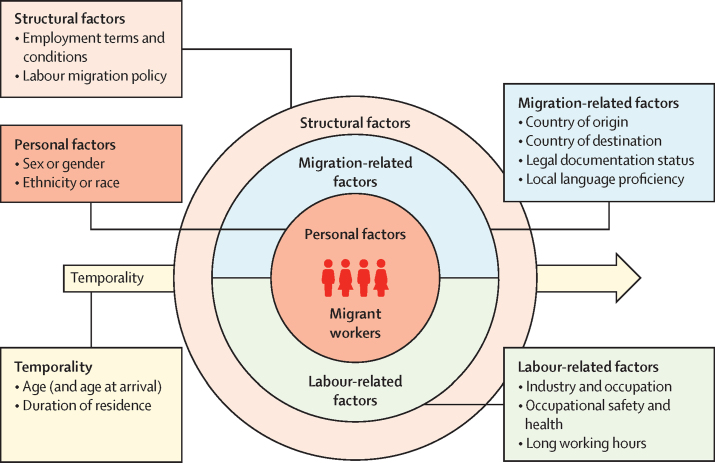
Figure 1. Diagram of the social determinants of migrant worker deaths (Lau et al., 2023)A multilayered circular diagram: “Personal factors” at the center, with structural factors, migration-related factors, and labor-related factors in successive outer layers. Detailed items for migration-related factors (country of origin, destination country, legal status, language and culture, etc.) and labor-related factors (industry, occupation, occupational safety, long working hours, etc.) are listed.
Reducing Suicides Among Migrant Worker: A Challenge for the South Korean Government
Migrant workers in Korea come to a place with an entirely different culture and language out of desperation. Under the oppressive Employment Permit System, they learn mostly unfamiliar work for the first time and are targets of discrimination. They face extremely severe stress. To reduce migrant worker suicides, the government must first do the work of finding intervention points, through an accurate picture of the situation, cause-of-death statistics, psychological autopsies, and similar efforts. These points of intervention could include changes to institutions such as the EPS, measures to ease migrant workers’ economic vulnerability, efforts to protect them from predatory debt relationships, measures to reduce discrimination against migrant workers, and efforts to promote their mental health and prevent suicide.
These policy tasks were already set out in the 2024 NHRC study. We hope the newly established ‘Division for the Improvement of Occupational Safety and Health Disparities’ in the Ministry of Employment and Labor will play a role in developing countermeasures by paying comprehensive attention not only to work-related accidents but also to all migrant worker deaths, including suicide and to health problems in general, including mental health.
Comments