The Fight for the Safe Rates System Is Far From Over (Mar. 2026)
Jeon Ju-hee(Director of Working Hours Center and member of Seogyo Institute for Humanities and Social Sciences)
Translated by Michelle Jang
In 2024 alone, 594 people were killed in collisions with freight trucks on South Korea’s roads. According to the Korea Road Traffic Authority, this accounted for 23 percent of all traffic fatalities nationwide, which totaled 2,521 deaths. More alarming is the fatality rate of truck-related accidents. Data from the Korea Expressway Corporation shows that between 2021 and 2023, traffic accidents involving trucks had a fatality rate of 11.5 percent—significantly higher than the 8.4 percent rate for other vehicles. During the same period, 54 percent of all traffic deaths on the nation’s expressways were caused by accidents involving large freight trucks.
The danger becomes even more alarming in the rain. According to the Korea Road Traffic Authority, between 2022 and 2024 the fatality rate of truck-related accidents on expressways during rainy conditions was 5.6 times higher than in clear weather, reaching 6.94 deaths per 100 accidents. In short, when it rains, it’s best to stay clear of freight trucks on the highway.
How Neoliberalism Turned Freight Trucks into “Outlaws on the Road”
The main causes of truck accidents are drowsy driving and driver inattention, which have led freight vehicles to be labeled “outlaws on the road.” These, in turn, are linked to overloading, speeding, and overwork. They also express the conditions of freight workers’ lives and labor under neoliberalism. At its root lies deregulation aimed at accelerating the flow of commodities within a neoliberal production system.
In 1997, South Korea enacted the Trucking Transport Business Act. In periods of capitalist crisis, when profit rates fall, capital must accelerate the speed of circulation in order to restore profitability. To remove regulations seen as obstacles to this process, the state pursued what was framed as “management reform in the freight transportation industry.” This was accompanied by the polished rhetoric of deregulation—namely, “lowering barriers to market entry and promoting greater diversity in market transaction structures.”
The direction of deregulation was the individualization of truck ownership. The new law—which introduced a comprehensive vehicle registration system, liberalized freight rates, and permitted subcontracting-based management systems—fundamentally reshaped the logistics and transportation industry. In the aftermath of the IMF financial crisis, many workers who suddenly lost their jobs either opened small fried chicken restaurants or took on debt to become both owners and drivers of freight trucks, so-called “owner-drivers.” In Korea, this arrangement is known as ji-ip (持入), referring to a system in which individuals own their vehicles while remaining formally affiliated with transport companies.
The long-standing practice of large transport companies directly employing truck drivers quickly disappeared. In its place emerged a system no longer based on employment contracts and employer–employee relationships, but on commercial transactions centered on vehicle ownership (ji-ip) and freight subcontracting agreements. Today, more than 90 percent of drivers in South Korea’s freight transport sector are owner-operators. Transport companies sold the trucks they previously owned to workers and signed ji-ip and subcontracting agreements with them. In reality, however, only the contractual form changed: truck drivers continued performing the same work as before, but they were reclassified as “vehicle owners” rather than “workers.”
Freight transactions have become increasingly complex. Between shippers (cargo owners) and owner-operator drivers who carry out the actual transport work, intermediary actors such as transport companies and freight brokers have proliferated. As this multi-layered transaction structure has deepened, the share of freight charges ultimately reaching freight workers has declined. In practice, after various brokerage fees are deducted through multiple layers of transport companies and freight brokers, freight workers receive only 60 to 70 percent of the freight charges paid by shippers.
<The Multi-Layered Structure of Freight Rates>
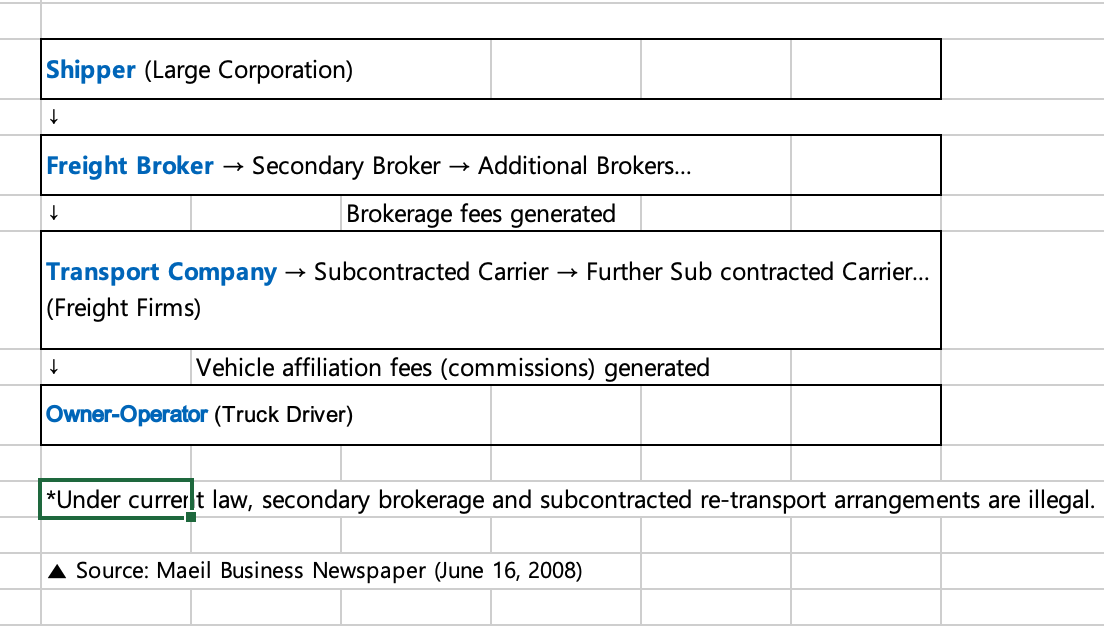
The defining feature of all multi-layered subcontracting systems is the rationalization and legitimization of labor brokerage and intermediary exploitation. Freight transport workers likewise suffer from intermediary exploitation under these multi-tiered transaction structures. Neoliberal reforms have transformed the freight transportation industry into a form of vampire capitalism, compelling freight workers to bear the risks of overloading, speeding, and overwork.
The Safe Rates System’s Strategy: Reducing Overwork
Overloading, speeding, and overwork are interconnected phenomena, but they operate on fundamentally different levels. Overloading and speeding are unsafe practices in freight transport, whereas overwork concerns the sustainability of the human body and life itself. Overloading and speeding embody a neoliberal obsession with speed. Yet this very excess is also one of neoliberalism’s objectives. On the surface, it appears to align with the interests of truck owners, whose vehicles often cost hundreds of millions of won. But what about overwork? Overwork, however, has its limits. It begins where physical exhaustion exceeds the threshold of self-directed effort and achievement. Overwork is not autonomous but imposed. Even for truck owners, overwork may appear to be a choice—but in reality, it is a “forced choice.”
The dual and contradictory status of the owner-operator freight worker—simultaneously a truck owner and a transport worker—tended to collapse overloading, speeding, and overwork into a single problem. In contrast, the Safe Rates System advanced by freight workers separated the issue of overwork from that of overloading and speeding. It targeted the conditions that compel overwork, particularly the low wages generated by a multi-tier subcontracting structure. In doing so, it revealed that the structurally distorted logistics industry—one that drives workers toward overloading and speeding—is itself a source of social risk.
Neoliberalism excluded freight transport workers from the category of wage labor. In response, freight workers organized through the founding of the Cargo Truckers’ Solidarity (KPTU-TruckSol) in 2003. From the outset, the union launched a struggle to defend freight workers’ livelihoods and transform the logistics market. One of its central demands was the establishment of a Standard Freight Rate System that would guarantee fair freight rates. The Safe Rates System, implemented from 2020 to 2022 under a three-year sunset clause, was the product of 18 years of struggle by the Cargo Truckers’ Solidarity. The shift from a “Standard Freight Rate System” to a “Safe Rates System” was decisive. By foregrounding the problem of freight workers’ overwork, it redefined what had previously been framed as an issue of correcting unfair trade practices and standardizing the industry as a matter of social risk.
A particularly important feature of the Safe Rates System is that it guarantees income for workers in so-called “special employment” arrangements without requiring a struggle for legal recognition as workers under the Labor Standards Act or the Trade Union Act. Rather than centering its strategy on claims to worker status, the system identifies the neoliberal employment status of the “owner-operator freight worker” itself as a root cause of overwork. The core of the Safe Rates strategy is to identify the “economic employer” within complex supply chains and multi-layered subcontracting structures—the actor that effectively controls workers’ pay and working conditions—and hold that actor accountable. This suggests a broader possibility: the approach may serve as a common strategy for platformized labor more generally.
Implemented for three years beginning in 2021, the Safe Rates System brought changes to both the safety of freight workers—many of whom had long endured working more than 13 hours a day—and the industry’s multi-layered subcontracting structure. According to a survey conducted by the Cargo Truckers’ Solidarity alongside the implementation of the system, the average number of intermediary stages in the subcontracting chain fell from 1.76 to 1.36. As a result, low-price competition for freight contracts eased, with survey scores declining from 4.47 to 3.79. The level of intermediary exploitation by transport companies and freight brokers also decreased significantly, falling from 3.92 to 3.11. Correspondingly, freight workers reported fewer experiences of overloading, which fell from 24.3 percent to 13.6 percent (a decrease of 9.7 percentage points), speeding, which fell from 32.7 percent to 21.7 percent (11 percentage points), and drowsy driving, which fell from 71.8 percent to 51.0 percent (20.8 percentage points).


Democratizing Safety: An Anti-Neoliberal Form of Resistance
The connection between “safety” and “freight rates” may seem neither particularly new nor entirely convincing. It is hard to deny that trade unions have long invoked safety as a rhetorical justification for wage demands. Yet the Cargo Truckers’ Solidarity’s struggle for the Safe Rates System represents something different. It has sought to reconstruct the very meaning of “safety” itself. The movement not only shifts responsibility for safety—previously individualized and imposed on workers—onto capital, but also highlights how risks generated within the labor-capital relationship are displaced onto society at large, producing another social problem: the phenomenon of “outlaws on the road.” In this way, it advances the democratization of safety in opposition to neoliberal notions of safety, characterized by individualization, commodification, and privatization.
The “Safe Rates System” was first advanced in the late 1990s by the Transport Workers’ Union of Australia (TWU) as part of its struggle against the deregulation of the road transport industry. Since then, the demand for safe rates has spread across different countries and regulatory regimes, extending throughout the increasingly platformized logistics, transport, and delivery sectors. Yet nowhere in the world has a fully developed Safe Rates System been established—one that effectively holds employers accountable while strengthening the power of workers and their unions. South Korea is no exception. Under the Yoon Suk Yeol administration, the system was abolished when its sunset clause expired, and under the Lee Jae Myung administration it was reintroduced, but only under another three-year sunset provision. The next three years are likely to witness a fierce second round of struggle between a logistics and transport industry at the forefront of platformization and freight, transport, and delivery workers who have been stripped of formal worker status. At the center of this struggle lies the safety of both workers and the public.
Comments